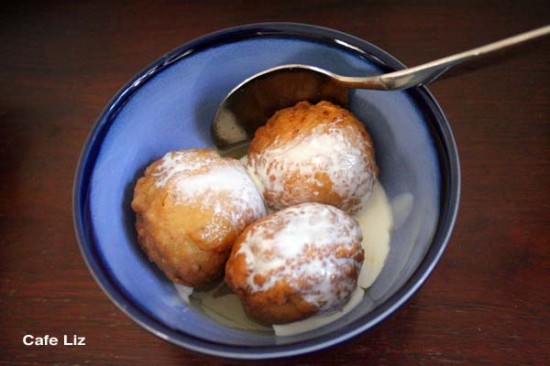
My mother learned to make bimuelos from her maternal grandmother, who brought the recipe with her from Istanbul, along with her special bimuelo pan. I don’t know anyone else who makes bimuelos for Passover, beyond my immediate family. And it’s a pity. They’re quite good. The word bimuelo merely means a fried dough delicacy in Judeo-Spanish. You could consider my family’s version a kind of Sephardi matzo ball — the batter is similar, but instead of being cooked in chicken broth, we fry ours, boil them in honey-sugar syrup, and then serve them doused in sweet cream. We eat them for breakfast every day of Passover. How could you go wrong?
Passover bimuelos have made the holiday for me ever since I can remember, yet they seem to be a lost art. Over the years, I’ve tried searching for the word on Google. In 2003 I turned up a whopping three hits. By last year things had slightly improved, up to about 20, including a Judeo-Spanish dictionary, a lecture in Ladino, a few articles about Hanukkah sweets, and a dozen photos I’d posted over the past few years. This leads me to think the world is in need of a bimuelo revival.
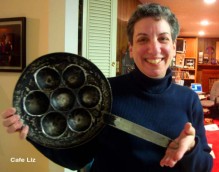
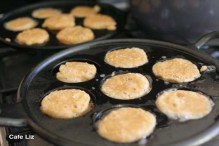
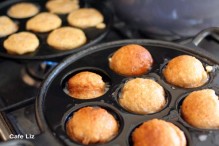

The bimuelo pan has seven wells. You fill them with batter, which then swells into perfect balls. The pan is apparently also used for making Hannukah donuts, as well as a Danish treat called aebleskiver by those who don’t realize it’s a bimuelo pan. I found a decent pan at 4 Chef a few years ago, for 80 shekels (you can get a similar pan in the U.S. from Fante’s or on Amazon). It’s cast iron, which makes it quite heavy, but it also cooks the bimuelos very nicely. For the past five years, it’s been turning out fine little golden dumplings every Passover. Not quite the record my mother’s pan has, but a good start nonetheless.
In order to decrease the competition for my mother’s heirloom pan, I decided to give my sister her own bimuelo pan for Hannukah last year. I lugged the heavy hunk of iron in my luggage all the way from Ben-Gurion Airport to JFK, getting some strange looks from baggage scanners on the way. Lo and behold, when I presented my sister with her pan, her face registered surprise, and then she and my mother began to laugh. Because it seems my brother had the same idea that year — he had decided to buy me a nice bimuelo pan as well. So I basically flew 11 hours to trade one cast-iron pan for another.
So now I have two bimuelo pans. It turned out to be a major time-saver — I prepared my batter in no time at all this year. And since tomorrow is my birthday, I’m planning to stick a few candles into a bimuelo or three, and call it a cake.
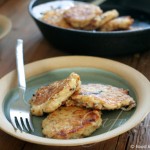
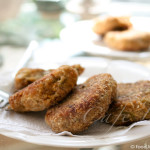
(The photos: My mom with her antique bimuelo pan, bimuelos ready to be flipped, bimuelos that have just been flipped, and me working my bimuelo factory a few years ago.)
And with no further ado, my family’s bimuelo recipe:
For 32 bimuelos (based on 2 1/8 inch wells):
1 cup matzo meal (give or take)
10 medium-sized eggs
1 cup sugar
1 cup honey
Oil
Crack eggs into a bowl. Slowly beat in the matzo meal. Let it sit for a few minutes; the matzo meal will absorb some of the liquid from the eggs and thicken. You want the batter to have the consistency of a cake batter — not runny, but also not stiff. Add a little more matzo meal if you need.
Meanwhile, prepare the syrup bath: Put the honey and sugar in a large pot, and fill with enough water to boil the fried bimuelos (the water should be at least two bimuelos deep). Bring the liquid in the pot to a low boil.
Put the bimuelo pan on a medium flame. Pour a bit of oil into the wells. Once it begins to get hot, scoop a heaping tablespoon of batter into each well (more or less, depending on the specs of your pan). You don’t want the batter to drizzle or drip into the well, because it will cook unevenly and the dumpling won’t be smooth on the outside. Also, don’t add extra batter on top of the original scoop — same reason.
Once bubbles begin to form on the top of the batter, flip each dumpling over in its well. The now-exposed bottom side should be golden. If it’s burnt, turn down the heat.
(If you don’t have a dedicated dumpling pan, you can try deep-frying the batter in a few inches of oil, or arranging some metal rings for cooking eggs in a regular pan. I admit that I haven’t tried this, so I don’t know how well the dumplings will hold their shape.)
Once both sides are golden, dump the bimuelo into the boiling syrup bath. This is what will make it soft inside. Let it boil until you can feel with a fork that it has no hard center. Remove cooked bimuelos to your storage container.
Repeat for the rest of the batter, adding more oil to the pan as necessary. When you’re done, pour the syrup into the storage container, so that the bimuelos are stored in liquid. This keeps them soft.
Chill, and serve with a few spoonfuls of the syrup and a good dousing of sweet cream (You can forgo the cream if you want this to be parve, but it’d be a pity.)
Your bimuelos are welcome here!
I’m loving all the comments about other kinds of bimuelo traditions, and you’re more than welcome to tell me (and the many other readers — this is one of my most popular posts) about it. What city does your recipe come from? Who is the relative who made it? Is it made with matzo or matzo meal, deep fried or pan fried, boiled in syrup or served with honey, or something else altogether?