June 3, 20108 Comments

Green tea brioche with sweet beans

Much like we westerners like Japanese food, but alter it to suit our tastes, Japanese people like western food, but often with a Japanese twist. At the Uomo subway station in Tokyo, there's a little bakery full of western-style breads (OK, there are actually tons of such bakeries), where you take a tray and neatly fill it with pastries from the display (with tongs, of course). Here it is that we discovered green bread -- green tea flavored, to be precise, with ribbons of sweet azuki bean filling. And it was excellent.

In Japan, green tea and sweet beans are popular flavors for many things, but for some reason, it hasn't caught on anywhere else I've ever been. This means if you want these flavors, you'll have to make it yourself.

It so happened that I had a surplus of sweet azuki beans (well, I made mochi and cooked way too much azuki filling), so I decided to try to recreate this bready Japanese wonder.

I started with a few different brioche recipes, and while I originally had been planning to go all out and pack in the butter, when push came to shove, I couldn't bring myself to use more than 3/4 cup.
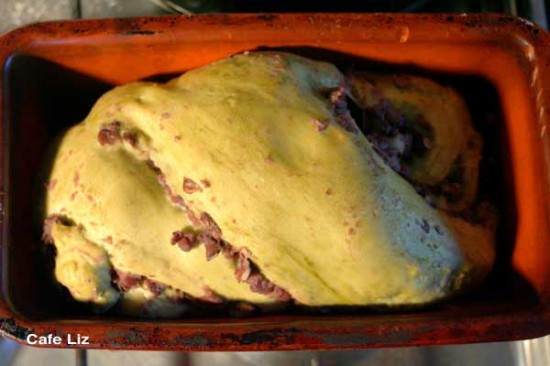
The result was pleasantly sweet, silky soft, and while the green tea wasn't overly prominent, the beans went very well.

This quantity of dough works well when split into two 4-by-8 inch loaves (or several smaller buns) -- after the bread was done rising and baking, each pan was about 80% full.

For two smallish loaves:

3 cups flour
2 teaspoons yeast
1/2 cup milk
2 tablespoons sugar
3 eggs
2 tablespoons matcha green tea powder
150 grams butter

1 cup cooked azuki bean filling (1/2 cup azuki beans, soaked for 24 hours, then cooked until soft with 1/4 cup sugar and a pinch of salt, and lightly mashed)

First, mix together about half a cup of flour, the milk, the sugar and the yeast. Let sit to proof -- you want it to get all bubbly.

Then, work in the rest of the flour, the matcha powder and the eggs. Slowly incorporate the butter -- the batter will wind up being much wetter and stickier than your standard bread dough.

Leave the dough to rise, until it doubles in size.

Punch down the dough, and knead/mix it again. Now you'll want to shape the rolls, and add the azuki beans. It might be easier if the dough is cold.

Roll out the dough into a flat rectangle (or two), top with beans, and roll up. Give the roll a twist for added interest. Let the loaves rise until they're a good size (for an hour or so, but it depends on your room temperature).

Bake at 180 degrees Celsius (325 degrees Fahrenheit) for about 30-45 minutes, or until the bread sounds hollow when tapped.

MORE ON BRIOCHE:
Related Posts:

|

8 Comments »

Have something to say? Tried a recipe and liked it, or want to suggest a variation? You're invited to post it here. RSS feed for comments on this post. TrackBack URI

  1. My first experience with adzuki beans was bean shake in Beijing- a wonderful Asian/Western food fusion. This weekend in London I had lots of red adzuki bean pastries in their Chinatown. It reminds me alot of dates. Both are very sweet and sticky

    Comment by Sarah — June 3, 2010 #

  2. Lovely Brioche!
    Exeptional with that green tea.
    Thx.

    Comment by bobbinis-kitchen.com — June 5, 2010 #

  3. I’m going to have to seek out macha powder and azuki beans. This looks well beyond delicious!

    Comment by BookishIma — June 7, 2010 #

  4. I love the Chinese and Japanese pastries made with sweet bean fillings and western type doughs. Your red bean brioche looks and sounds scrumptious. Bravo! Do you find azuki beans readily available in Tel Aviv?

    Comment by Faye Levy — June 9, 2010 #

  5. Hi Faye, yes, azuki beans are quite easy to get in Tel Aviv. I buy mine from the barrel at Nitzat Hadovdevan, but I think most any health food store would carry them, and possibly many of the bean/nut shops at the markets, too.

    Comment by Liz — June 9, 2010 #

  6. Sarah, that’s a very interesting comparison — substituting dates where the Japanese would use azuki. Date-filled mochi, perhaps?

    Comment by Liz — June 14, 2010 #

  7. This looks so interesting. I haven’t heard of anything quite like it. I need to restock on my matcha supply. Lovely.

    Comment by Shaheen {The Purple Foodie} — June 28, 2010 #

  8. Thanks, Shaheen! BTW, your lemon-grass growing method worked great.

    Comment by Liz — June 30, 2010 #

Leave a comment

After you submit a comment, it should appear above, even if it's been held for moderation. If it doesn't appear, that means it's been pegged as spam. Please contact me directly to let me know.

In order not to get falsely pegged as spam, if you're a first-time commenter, please don't post anything that looks like a form letter, or include links (you can write out the name of the web site, or send links to me in a message, and I'll add them to your comment).

XHTML tags that can be used: <a href="" title=""> <abbr title=""> <acronym title=""> <b> <blockquote cite=""> <cite> <code> <del datetime=""> <em> <i> <q cite=""> <strike> <strong>

Cafe Liz: Kosher vegetarian recipes, Israeli food culture, a mix of the Mediterranean and the Middle East.

All content and photos copyright 2008-2012, Liz Steinberg. All rights reserved. Please seek permission before republishing.
Powered by WordPress with theme based on Pool design by Borja Fernandez.

All content and photos copyright 2008-2012, Liz Steinberg, at Cafe Liz (food.lizsteinberg.com). All rights reserved. Please seek permission before republishing.