Indo-Chinese stir-fried noodles

August 12, 2010 at 12:00 pm | Tags: , , , , , , , | 10 Comments

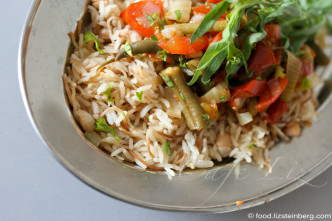
Chinese by Indians. A simple yet strange concept, I was introduced to this cuisine when my friend Iris returned from a year in India. It was one of her favorite things to eat there. It came to into existence thanks to Chinese who migrated to India, and adopted their native cuisine to suit the local palate. I was inspired to try it myself by a post on Hakka noodles by Soma on eCurry.

What makes this dish explicitly Chinese? Well, there are the egg noodles and the tofu, as well as the soy sauce, sesame oil and sugar. What makes it Indian? There’s the cilantro, the tamarind and the tomatoes. The rest of the ingredients can be found in both cultures.

What distinguishes this from another east-west fusion dish? Couldn’t this same dish have been made, say, by Westerners cooking Thai? It seems so to me, at least. Particularly because this recipe is my interpretation of Indo-Chinese dishes. Indo-Chinese by a Westerner? That definitely describes it.

But regardless of how you look at its cultural identity, this is a fabulous combination of flavors — tart from the tamarind, sweet from the sugar, salty from the soy and spicy from the chili (all key flavors in Thai cooking, mind you). Plus, it’s rich from the plump egg noodles, and chock full of vegetables. In short, it’s now one of my favorite ways to stir-fry egg noodles. Continue reading Indo-Chinese stir-fried noodles…

Israeli chopped salad

August 8, 2010 at 12:00 pm | Tags: , , , , , , , | 7 Comments

There’s nothing more debilitating to a food blogger than having no appetite. And frankly, in this oppressive summer heat, not only have I not wanted to cook, I haven’t even wanted to eat. I have a theory that when your body needs less energy to warm itself, you don’t need as many calories. I wonder if science backs me up.

In fact, one of the few things I’ve been eating as of late are Israeli salads. Some people call them Arab salads (it’s all politics, ultimately), while in Hebrew, they’re often simply called chopped salads.

The base is always the same — little chopped cubes of tomatoes and cucumbers. That’s the basic salad you get at falafel shops. In order for cucumbers and tomatoes to carry an entire salad, they have to be fresh and ripe. Now that it’s summer, you can expect to find plenty of these — the cucumbers here are no longer greenhouse-grown, and the tomatoes are bright red and juicy — as they were once, people like to say. Americans, read: No tomatoes picked green and unripe, and then transported two weeks. That will make your salad taste like cardboard.

Once you’ve got your base, you can dress it up with all sorts: Continue reading Israeli chopped salad…

Brunch: Poached eggs in bird’s nests, and grilled asparagus

July 23, 2010 at 1:00 pm | Tags: , , , , , | 4 Comments

This brunch looks complicated, but it’s actually quite quick and simple to pull together: You pack the kadaif noodles into bowls and stick them in the toaster, toss the asparagus (or vegetable of choice) into a pan to grill, and let the eggs boil for a minute or two in the meanwhile. Then you assemble it. That’s all.

As a bonus, it tastes good and looks nice — the nest comes out crunchy and buttery, and soaks up the liquid egg yolk. And fresh vegetables are (almost) always welcome. Continue reading Brunch: Poached eggs in bird’s nests, and grilled asparagus…

Ice limonana — mint lemonade, the drink of the Israeli summer

July 4, 2010 at 2:00 pm | Tags: , , , , , | 15 Comments

Limonana is the quintessential drink of the Israeli summer. Simple and ubiquitous, there’s nothing more refreshing than freshly squeezed lemons and ground sprigs of mint, whether served on ice or blended into a smoothie.

In the summer, limonada becomes my social drink of choice — the drink that captures the spirit of the moment, a pleasant afternoon nestled into a chair in a lively streetside cafe. In the winter, I order a cappuccino; in the spring and early summer, I make that iced coffee; and once even milk is too heavy for the oppressive summer heat, I get limonana. Big, green and frothy, and very cold, please. Continue reading Ice limonana — mint lemonade, the drink of the Israeli summer…

Thai papaya salad

June 30, 2010 at 9:06 pm | Tags: , , , , | 6 Comments

It’d been a while since we dared to enter the Carmel Market on a late Friday afternoon. At that hour the shook is packed, so crowded you can barely move. The first sign it was late in the day (as if we needed one) was when I went to my greens guy and asked for a head of lettuce. He gave me four. Four heads of fluffy, curly lettuce. They filled an entire grocery bag. I guess he likes me as much as I like him.

As Eitan wilted in the heat, we cut a quick retreat down a side alley, coincidentally (or not) passing one of the far-east specialty stands. Among the many things that require cooking and the sundry strange gourds was a pile of green papayas — green, crunchy, watery papayas, which get chilled and grated into refreshing, Thai salads. I snatched one. Continue reading Thai papaya salad…

Ravioli with mulukhiya and sweet potato

May 20, 2010 at 12:30 am | Tags: , , , , , , | 11 Comments

A decidedly local green has started poking through the mass of exotic mushrooms, Thai eggplants and other cultivated specialties at the Carmel Market -- shoots of mulukhiya, a Middle Eastern specialty somewhat strangely known as Jews' mallow. In some markets around Israel, especially those catering to a more mixed Arab-Jewish population, it's quite common -- at the Ramle market, you can get cultivated mulukhiya even when it's out of season, as fellow blogger Sarah told me -- but in Tel Aviv it's a good deal less common.

Mulukhiya, also written mloukhieh, is the Arabic name, which is also used in Hebrew; some sources say the name comes from the similarly written Arabic root for "royal." It's a member of the jute family, corchorus, a word that means, somewhat less elegantly, "mucose."

Uncooked mulukhiya has a smell that somewhat reminds me of asparagus; the cooked stew has gumbo-like properties that will please people who like okra in all its gooeyness. While obviously the number of ways to prepare mulukhiya varies along with the number of cultures (households? cooks?) who call the dish their own, but one traditional, fairly common means of preparation calls for plucking the leaves from the long, spindly stems and quickly boiling them into a viscous stew, flavored with fried garlic. This is the Egyptian method, and can also be found in Israel, as I confirmed with some of the friendly market sellers.

I picked up a bunch from the stand behind the juice-seller on Yihyeh Street (parallel to the main Carmel strip), who also offered me a few fresh chickpeas and tiny sour plums to try. I picked up about 400 grams at 10 shekels a kilo, which isn't bad, although you only use the leaves, not the stems (which make up the bulk of the weight). Since then, I've noticed mulukhiya being sold at some of the greens stands inside the main Carmel strip, too.

Since making my mulukhiya into a stew would have been too obvious, I decided to incorporate it into a filling for ravioli, mixed with sweet potatoes. After all, why not? Continue reading Ravioli with mulukhiya and sweet potato...

Thai red curry

April 25, 2010 at 2:00 pm | Tags: , , , , , , , | 4 Comments

In the back of my fridge is a slowly shrinking bag of green mush that I've been guarding jealously. It's the remainders of the half-kilo of handmade green curry paste that we purchased from our favorite restaurant in Chiang Mai, longer ago than I should probably admit (OK, it was a year and a half ago). How could I use it generously when I knew that once it was gone, the only replacement I'd find was something imported in little plastic tubs whose quality and flavor were complete unknowns?

Now, the biggest barrier to making fresh Thai curry in Israel has been lifted -- fresh galangal is here, and I've bought a nice, fat root that should last me a while.

Mind you, there are still other challenges, as there are whenever you try to prepare a foreign cuisine. Beyond the question of whether foreign flavors meet local tastes, there's the whole matter of ingredients -- looking at this list of Thai vegetables, you'll probably notice a whole lot that you'll never find here (well, not yet, at least).

But negatives aside, we now have access to nearly all the main aromatics, the things that set the taste. So I whipped up my very own batch of curry paste, and while they might do it a bit differently in Thailand, it happened to taste quite good. And that's the most important thing. Continue reading Thai red curry...

Chocolate Passover biscotti

April 1, 2010 at 4:00 pm | Tags: , , , , , , , | 4 Comments

These biscotti have a tendency to vanish. Biscotti are twice-baked cookies, once into a loaf, and the second time after being sliced, and until crunchy. Something about the denseness means they don’t lose much — if anything — from being made with matzo meal instead of flour, and thus kosher for Passover.

I got the recipe from my mother, who explained to me that she never bakes the full batch at once, because however much you bake, it immediately disappears. I baked mine before the holiday officially began, and thus kept myself from eating them — no Passover food until it’s Passover.

So first thing after getting home from the seder, I made a beeline for the cookies — yes, after a four-course meal and all. And it’s only been downhill from there.
Continue reading Chocolate Passover biscotti…

Matzo balls in Persian fruit soup

March 28, 2010 at 3:00 pm | Tags: , , , , , , | 11 Comments

I had a particular Persian meatball dish in mind when I made this — meatballs stewed in a broth of dried fruit. Fruit plays a central role in savory cooking in Persian cuisine. While dried fruit is more commonly associated with another holiday, Tu Bishvat, Passover also happens to fall in the spring, and thus fruit is still appropriate.

In this dish, it gives Ashkenazi matzo balls an unusual twist. The matzo balls provide firm texture in place of meatballs, and the fruit soup — well, it speaks for itself, a mix of sweet and savory thanks to some onions and garlic.

In terms of the fruit you use, you could follow my lead, or improvise. Continue reading Matzo balls in Persian fruit soup…

Cranberry charoset

March 24, 2010 at 12:30 am | Tags: , , , , , , | 2 Comments

cranberry-charoset

This is a play on a classic charoset — a Sephardi-style nut/date spread with a decidedly new-world twist. Cranberries are a new-world fruit, so it’s highly unlikely that they started appearing in any traditional Jewish cuisine too many centuries ago. But hey, it’s been 500 years since Columbus sailed the ocean blue and the world is increasingly globalized, so there’s no reason not to give our holiday “mortar” an extra cranberry tang.

Beyond the cranberries, there are the pears and the pecans, which give the charoset a decidedly upscale taste. What better way to deck out the seder table? Continue reading Cranberry charoset…

Next Page »

All content and photos copyright 2008-2010, Liz Steinberg. All rights reserved. Please seek permission before republishing.
Powered by WordPress with theme based on Pool design by Borja Fernandez.
Entries and comments feeds. Valid XHTML and CSS. ^Top^

All content and photos copyright 2008-2010, Liz Steinberg, at Cafe Liz (food.lizsteinberg.com). All rights reserved. Please seek permission before republishing.