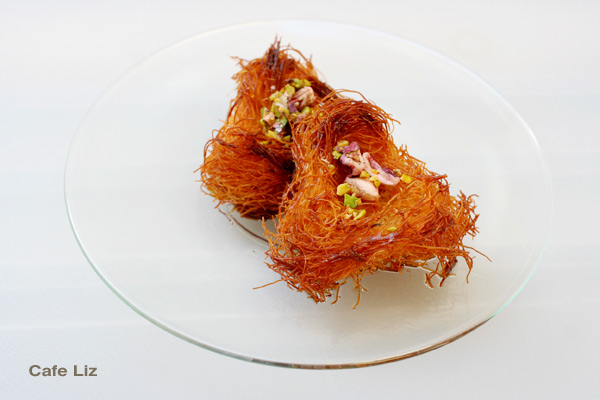
Purim special: Hamentaschen-shaped bird’s nest baklava

February 20, 2010 at 8:00 pm | Tags: , , , , , , , ,

Purim is approaching, and while I haven’t decided on a costume, I did decide to dress up my hamentaschen in Middle Eastern outfits. Hamentaschen are traditional Ashkenazi Jewish cookies notable for their three-pointed form, which according to tradition resembles the three-cornered hat of Haman, the holiday’s antagonist. (In Hebrew, for some reason, they’re called oznei haman, or “Haman’s ears.”) Last year I dressed up my hamantaschen as Japanese-inspired mochi cookies, this year I they resembled Middle Eastern pastries.

The Purim story is set in first-century Persia, so it’s unlikely that Mordechai, Esther or Haman ever had baklava. While the Persians (or Ottomans) are thought to have invented baklava, filo came into being only somewhere between the 6th and the 10th centuries. But still, it’s a twist that makes me smile. Continue reading Purim special: Hamentaschen-shaped bird’s nest baklava…

Bookmark and Share

Lag Ba’omer: Food you can stick in the bonfire

May 11, 2009 at 1:00 am | Tags: , ,

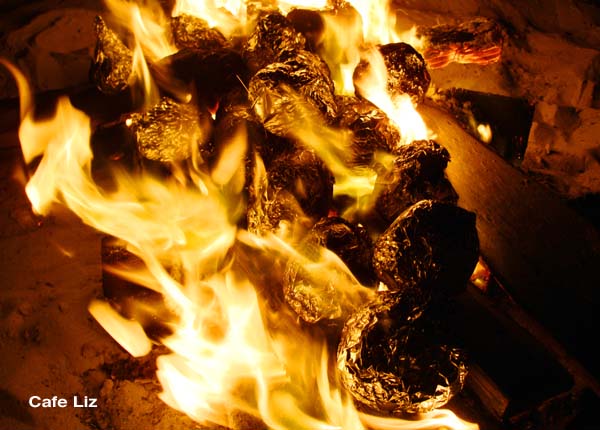
potatoes-in-bonfire

Tonight is Lag Ba’omer, the bonfire holiday, and the air will soon be thick with the smell of smoke. One of the possible interpretations for the holiday is that it marks the Bar Kochba rebellion in 132 C.E., which failed and led to the Romans destroying the Jewish settlement in the Land of Israel. No better reason to celebrate, right? Continue reading Lag Ba’omer: Food you can stick in the bonfire…

Bookmark and Share

Matzo balls with vegetable soup and Middle Eastern spices

April 14, 2009 at 1:00 am | Tags: , , , ,

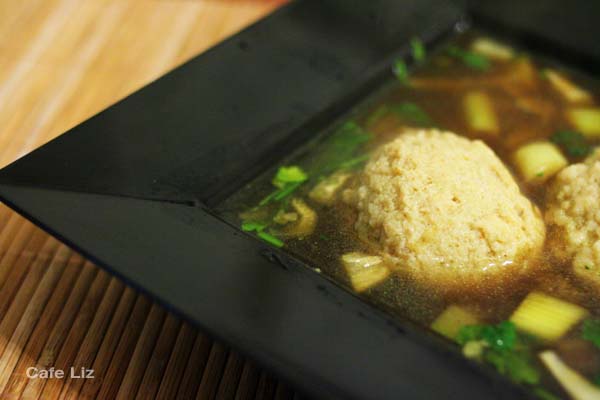
matzo-ball-soup

Sorry Maneschevitz, but I see no reason to make matzo balls from a mix — they’re pretty simple to make from scratch. I also think that the whole search for the perfect matzo ball recipe is a bit overrated. Matzo (matzah) balls are basically matzo meal mixed with egg, and everything else is simply a matter of taste. Maybe I’m saying this because I haven’t tried the world’s best matzo ball yet, but until that time comes, I’m happy with my own modest version.

Since there’s no chicken in our kitchen, this soup’s flavor had to come from something else. I put a bit of hot paprika in my matzo balls, and made a vegetable-intensive soup with Middle Eastern spices to go with them. There’s something to be said for matzo balls with a spicy kick. Continue reading Matzo balls with vegetable soup and Middle Eastern spices…

Bookmark and Share

Mina (Passover spinach pie)

April 12, 2009 at 1:00 am | Tags: , , , , , , ,

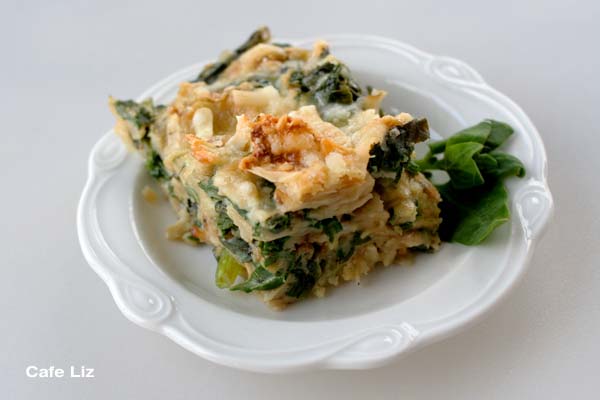
mina-spinach-pie1

This is another family recipe that simply means Passover to me. My mother learned this recipe from her Turkish grandmother and aunts growing up in Brooklyn. Apparently the word mina means pie in Judeo-Spanish (commonly known as Ladino), and the proper name for this recipe is actually mina de espinaka — spinach pie. My family seems to have shortened the name to mina, since we don’t really make any other kinds of traditional Turkish pies.

Believe it or not, my mother’s recipe calls for canned spinach — by the time my mother was a child, her grandmother had already switched to prepackaged convenience. I’m lucky enough to have an easy supply of fresh spinach, which I use instead — I get no strange flavors from the can or the freezer, and this is probably closer to how this recipe was made back in Turkey for generations (or so I’d like to believe).

Like all family recipes, this one was handed down to me without any actual measurements. So these are the quantities I use, and my preparation style. Continue reading Mina (Passover spinach pie)…

Bookmark and Share

Bimuelos (sweet Passover dumplings)

April 10, 2009 at 1:00 pm | Tags: , , , , , , , ,

bimuelos-in-bowl-2008

My mother learned to make bimuelos from her maternal grandmother, who brought the recipe with her from Istanbul, along with her special bimuelo pan. I don’t know anyone else who makes bimuelos for Passover, beyond my immediate family. And it’s a pity. They’re quite good. The word bimuelo merely means a fried dough delicacy in Judeo-Spanish. You could consider my family’s version a kind of Sephardi matzo ball — the batter is similar, but instead of being cooked in chicken broth, we fry ours, boil them in honey-sugar syrup, and then serve them doused in sweet cream. We eat them for breakfast every day of Passover. How could you go wrong?

Passover bimuelos have made the holiday for me ever since I can remember, yet they seem to be a lost art. Over the years, I’ve tried searching for the word on Google. In 2003 I turned up a whopping three hits. By last year things had slightly improved, up to about 20, including a Judeo-Spanish dictionary, a lecture in Ladino, a few articles about Hanukkah sweets, and a dozen photos I’d posted over the past few years. This leads me to think the world is in need of a bimuelo revival. Continue reading Bimuelos (sweet Passover dumplings)…

Bookmark and Share

My mom’s charoset

April 9, 2009 at 3:00 pm | Tags: , , , , , , ,

charoset

This is charoset like my mother makes it. It’s not so pretty, but then again, she says it’s supposed to look like the mortar that was used to build the pyramids (although some would argue that there was no mortar involved, only well-cut stones). Historical accuracy aside, this charoset is pleasantly sweet without being cloying.

There are hundreds of ways of making this traditional Passover spread, one of the key elements on the Seder plate. It can include a wide range of fruits, nuts, spices and wine; mine contains apples, walnuts, dates and raisins. Dates are a staple of Sephardi-style charoset, and this recipe is traditionally Turkish, although it may resemble charoset from other communities as well. Continue reading My mom’s charoset…

Bookmark and Share

Cafe Liz goes kosher for Passover

April 7, 2009 at 1:00 am | Tags: , ,

seder-plate-with-matzo

Cafe Liz is going kosher for Passover: I’ve cleaned the kitchen and thrown out last year’s matzo. Oh, and I’ve also gone through all my recipes, and pulled out the ones that suit the holiday, based on both Ashkenazi and Sephardi traditions.

Kosher for Passover recipes by Sephardi standards
Kosher for Passover recipes by Ashkenazi standards (kitniyot free)
Passover-specific recipes

If you keep Sephardi Passover like my family, you’re probably used to a vibrant, vegetable- and rice-filled Passover (I’m thanking my Turkish and Greek ancestors as we speak). In fact, I usually find that I have more things to eat over Passover, not less, because I cook more. Continue reading Cafe Liz goes kosher for Passover…

Bookmark and Share

Purim special: Mochi hamentaschen

March 10, 2009 at 10:00 pm | Tags: , , , , , , , ,

mochi-hamentaschen-fruit-fillings-cafe-liz

When we were in Japan, one of the things we ate on a daily basis was mochi -- the squishy, sticky, gooey sweetened rice snack, generally filled with azuki beans. That was one of the things that we missed, since you can't get it anywhere in Israel, so lo and behold, what did we bring back from our last trip to the U.S.? Mochi from Chinatown.

Anyway, lucky for us, I've since learned that mochi is pretty easy to make. The word mochi refers generally to a sticky rice snack. The rounded, filled dumplings we found at the corner grocery store and enjoyed on a daily basis are called daifuku, while the triangular cinnamon treats in Kyoto are more accurately known as yatsuhashi. However, the dough is more or less the same.

Come Purim, and it turns out that the mochi dough lends itself quite well to making hamentaschen-shaped treats. I admit that I didn't originally intend for my Japanese desserts to resemble Haman's hat (or ears, depending which story you believe). But for some reason, I utterly failed to make rounded bean-filled dumplings, and a tri-cornered creation was the most elegant shape I could come up with. Hence, mochi hamentaschen. Continue reading Purim special: Mochi hamentaschen...

Bookmark and Share

Latke bonanza, part 2

December 28, 2008 at 1:58 am | Tags: , , , , ,

This Hanukkah, we wound up making more than 7 kilos of latkes. Indeed, the holiday isn’t even over yet, but I think I’ve had enough fried food for oh, say, the next year. Anyway, in the course of these 7+ kilos, we quite refined our latke-making technique, and came out with some pretty good results. I’ve edited the recipes in the last post to reflect our fine-tuning, and I’m adding a few more here: Sweet potato latkes with Chinese spices, and Carrot cilantro latkes. Continue reading Latke bonanza, part 2…

Bookmark and Share

Latke bonanza

December 23, 2008 at 2:30 am | Tags: , , , , , , ,

I could never really get that excited about latkes, which I’d mostly experienced as patties of fried mashed potatoes. After all, I wouldn’t eat oily, soggy potatoes on other days of the year, so what made Hanukkah any different? But this year, I decided it didn’t have to be like that. Why not make latkes with other vegetables, seasoned like I season most anything else that comes out of my kitchen?

So I brainstormed a list of interesting taste combinations. In the end, I was limited by the amount of latkes we could possibly expect to make (and eat) in one night, and managed to make only four of the ideas I’d thought up: mushroom ginger latkes, pear sage latkes, eggplant shallot latkes and zucchini dill latkes. Continue reading Latke bonanza…

Bookmark and Share

All content and photos copyright 2008-2010, Liz Steinberg. All rights reserved. Please seek permission before republishing.
Powered by WordPress with theme based on Pool design by Borja Fernandez.
Entries and comments feeds. Valid XHTML and CSS. ^Top^