
April 14, 201022 Comments

Brandied loquats

All it takes is one ingredient to turn loquats (or any other stone fruit) into a sweet, alcoholic concoction: sugar. This fabulously simple preparation comes from my sister-in-law Ora, who got the basic concept from the Encyclopedia of Country Living. Ora presented us with little containers of brandied loquats for Purim. We couldn’t stop eating them, and we couldn’t believe they were that easy to make.

Now that loquats are finally coming into season, I gave it a try myself. Fortunately, I found some at the Carmel market, because I’d been eying the various loquat trees around town. The season is just beginning, so loquats are still a bit expensive — the least I found was 8 shekels a kilo — but the price will probably come down within the next few weeks, to 3 shekels or so. This is key, because this is a preparation that’s easy to make in bulk, and becomes ready only after a few months — but then lasts for at least a year.
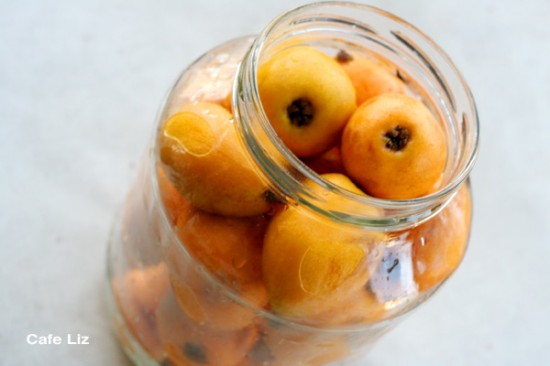
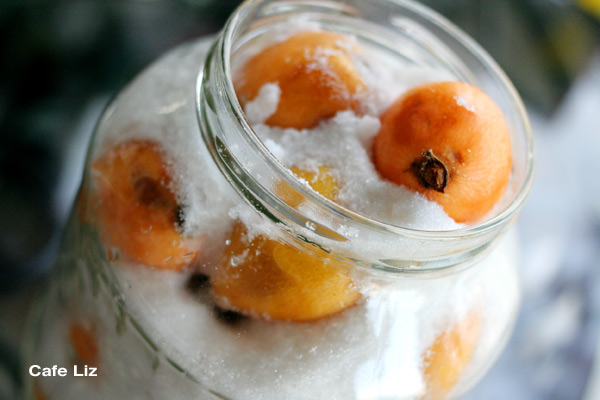
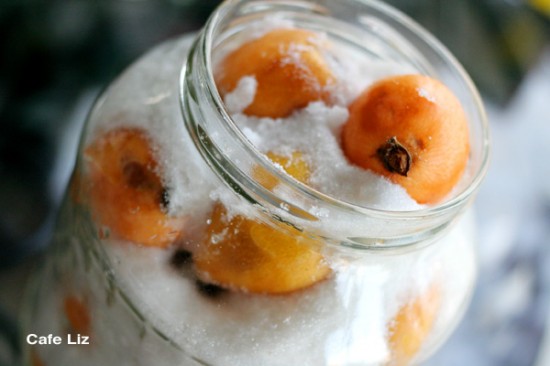
Basically, you rinse the loquats, put them in a clean jar of some sort, and then fill the jar with sugar. Peeling the loquats gives the sugar quicker access, and makes for a smoother eating experience afterward. I couldn’t pack my jar too tightly, so I wound up using 500 grams of sugar for 1 kilo of loquats. Then, you seal the jar, put it in a dark, cool place and let it sit for a few months. The loquats emit juices, the sugar helps them ferment, and lo and behold, you have sweet, alcoholic fruit.

My sister-in-law pointed out that the loquats at the top of the jar — which won’t be completely submerged in alcohol, since they float — turn an ugly brown. I’d recommend putting some sort of glass weight on top of the loquats (a jar, a plate — whatever fits) in order to prevent this.

Anyway, my jar has now been sitting for a week or so. I didn’t peel my loquats, so, the sugar in the bottom half of the jar is just beginning to collect enough liquid to dissolve.

This would also work with other kinds of firm stone fruit, such as peaches, plums or apricots.

Why loquats, by the way? For those of you who have never heard of a loquat, let alone seen one in person, they’re quite common here — Israel’s unofficial national fruit, if you will. Hence, I have many recipes with loquats.

Update: Here’s what the loquats look like 2 1/2 months later. The jar on the left is unpeeled loquats, and the one on the right is peeled loquats.

Related Posts:

|

22 Comments »

Have something to say? Tried a recipe and liked it, or want to suggest a variation? You're invited to post it here. RSS feed for comments on this post. TrackBack URI

  1. It supposedly also helps to keep it in a cool spot.

    Comment by Ora — April 14, 2010 #

  2. Oops, forgot to add that! Thanks for the reminder.

    Comment by Liz — April 15, 2010 #

  3. I am not so much fond of loquats,but this seems to be a nice way to use them.Besides the brandied fruit,is the liquid like liqueur? In past I have done something similar with fruit and rum,rumtopf, and it has been really yummy.I should try this with loquats.

    Comment by Yael — April 15, 2010 #

  4. Hi Yael, the liquid is alcoholic, although I haven’t tried drinking it — I imagine you could, though. What fruits did you use in your version?

    Comment by Liz — April 15, 2010 #

  5. I have never heard or seen this fruit. But this idea to treat the fruit the way u did sounds fantastic!

    Comment by Soma — April 15, 2010 #

  6. Thanks, Soma! I’ve heard from readers that it grows in North America, but farther south than where you live, such as in Florida and California.

    Comment by Liz — April 15, 2010 #

  7. I am actually in the southern parts of the states in Texas. If they are locally grown I should see them here, but haven’t so far. wonder if they could be called something else.

    Comment by Soma — April 15, 2010 #

  8. Oh, well, in that case, apparently they do grow in your area — I read that they’re also called Japanese or Chinese plums, if that rings a bell.

    Comment by Liz — April 15, 2010 #

  9. Another great recipe/idea to use fruits for. “..loquat trees around town..” For us in Germany it couldn’t sound more exotic.
    Thank you for posting!

    Comment by a-man — April 16, 2010 #

  10. When I was a child here in California we often ate loquats; they grow in people’s gardens here. But the last time I tasted a loquat was in Isreal, in 1995. The tour bus stopped and the guide bought us some from a roadside stand. Most of my fellow tourists were not familiar with this delicious fruit. I recently noticed a tree in a neighbor’s yard…and I’m very tempted to try this recipe…! I recall seeing a similar recipe described in Joanna Harris’ novel, Five Segments of Orange, but with cherries or berries…

    Comment by Sara — April 19, 2010 #

  11. Hi Sara, thanks for sharing! It’s always nice to hear about people’s personal experiences.

    Comment by Liz — April 20, 2010 #

  12. Hi Liz! I have a tree in my backyard and have been looking for ways to preserve and use the buckets full that I have (I’ve already given away as much as my neighbors can handle). This recipe sounds great! How do I know when they’re ready? And couldn’t we turn the jars over while fermenting to prevent the top ones from browning?

    Comment by Laurie — April 29, 2010 #

  13. Hey Laurie, the ones at the top turn brown pretty quickly if you’re using peeled loquats (which probably make a better final product than unpeeled ones, time consuming though it may be to peel them) — as in, an hour or two after the jar fills with liquid — so your best bet would bet to use a weight of some sort.

    I’m not entirely sure how to tell when they’re ready, aside from leaving it for a few months and then opening it to taste.

    Comment by Liz — April 29, 2010 #

  14. Hi Liz! More questions… Once sealed, is it best to keep the jars sealed until you think they’re ready? Someone said I should burp them. I was thinking the built-up pressure was part of the process. But I do have one jar that leaked, and another that looks like it’s about to blow it’s lid (though, I now believe, that’s being caused by air building up in the plastic wrap I have sitting on top). Also, should the sugar last throughout? Can that be an indicator as to when they’re ready? Or if it runs out before 2 months, should I add more (which brings us back to the first question)? One more question: I have read that the leaves are medicinal. Have you heard this? Do you know in what capacity? I’ve heard that tea made from the leaves are good for people with diabetes. Very calming. Can you tell me how to make tea (ok, so that’s three)? I’m clueless from start to finish. Sorry about the bombardment, but you appear to be the food guru. Thank you so much for your time and help.

    Comment by Laurie — June 2, 2010 #

  15. Hi Laurie, in response to your questions:

    First off, if pressure is building up in the container, you should probably leak it out — the process is basically like making liquor, and beer and wine makers give their caskets a valve to release extra pressure from the fermentation process.

    I don’t think you need to add more sugar. What happens is that the sugar dissolves in the liquid from the loquats, and then the bacteria feed on it to make alcohol and carbon dioxide (hence the pressure buildup). The bacteria die once they run out of sugar or the alcohol content gets too high, I believe.

    So if you don’t see any sugar, that probably means it’s all dissolved. However, even if all the sugar has fermented, letting the loquats sit in the alcohol syrup for a few months will improve their flavor. My prior experience in making infused liquors found the taste gets a lot better with time.

    As for using the leaves in tea, I have no idea whether people do that, but I’d want to find a reliable source before trying it. The loquat pits are poisonous, and I wouldn’t want to take a risk.

    Good luck!

    Comment by Liz — June 2, 2010 #

  16. Hi Liz, I have just passed your recipe (and link) to my sister in Peckham (south London) who has discovered a Loquat tree in someones garden full of ripe fruit! Yes here in the UK believe it or not.
    You may be getting begging e-mails for (to us) exotic recipes soon ! ! !
    Nick.

    Comment by Nick Greenhough — July 4, 2010 #

  17. I hope the recipe serves her well! I actually have heard that loquat trees can grow in England.

    I actually have a bunch of loquat recipes, and you can find them all here.

    Cheers, Liz

    Comment by Liz — July 4, 2010 #

  18. Great article and discussion! I just finished a fantastic loquat salsa from my backyard tree’s fruit. Delicious! About the pits: I’ve heard that a liquor can be made from them, and has an amaretto flavor. Since you say they’re poisonous, I can only assume they’re discarded after the fermentation process. Greetings from Oaxaca, Mexico!

    Comment by Shoshana — October 5, 2010 #

  19. Loquat salsa, that’s an interesting idea. I’ll keep it in mind for next loquat season.

    If you ever find out more about the loquat pit liquor, I’d be interested. Sounds similar to the process of making amaretto (apricot pits) but this is the first I’ve heard about it.

    Thanks for commenting!

    Comment by Liz — October 10, 2010 #

  20. I haven’t thought about the shezek tree at my house in Jerusalem in many many years. I enjoyed reading many a book under the shade of that tree. Thank you for the reminder of that lovely spring.

    Comment by Molly — March 11, 2011 #

  21. Loquats are ripe now in my area, so I’ve just found your recipe. I’ll try it tonight! Maybe peeling them will be too much work, but I’ve heard if you blanch them the peels come off easily.

    I have made a loquat tea from the leaves for a dry cough, as directed by an acupuncturist. The tea was also time consuming—there are fine hairs on the underside of the leaf that take some rinsing and rubbing to remove before boiling the leaves—but it didn’t hurt me, and seemed to help my cough. The syrup of the fruit itself also makes a good cough remedy, though, and is much more pleasant tasting.

    The almondy flavor of apricot pit liqueur comes from cyanide compounds—just like the almondy flavor of actual almonds. I presume loquat pits contain the same toxin. Like anything else with toxic compounds—coffee, chocolate, potatoes, spinach, alcohol—it’s the dose that makes the poison.

    Comment by Kerrick — July 6, 2011 #

  22. Hey, thanks for commenting. The information about the leaves is very interesting — I haven’t found much information about how they’re used.

    I’d also presume that loquat pits contain the same poisons as other fruit pits, but I have no idea, and I also don’t know how much you’d have to consume in order to feel the effects.

    Comment by Liz — July 7, 2011 #

Leave a comment

After you submit a comment, it should appear above, even if it's been held for moderation. If it doesn't appear, that means it's been pegged as spam. Please contact me directly to let me know.

In order not to get falsely pegged as spam, if you're a first-time commenter, please don't post anything that looks like a form letter, or include links (you can write out the name of the web site, or send links to me in a message, and I'll add them to your comment).

XHTML tags that can be used: <a href="" title=""> <abbr title=""> <acronym title=""> <b> <blockquote cite=""> <cite> <code> <del datetime=""> <em> <i> <q cite=""> <strike> <strong>

Cafe Liz: Kosher vegetarian recipes, Israeli food culture, a mix of the Mediterranean and the Middle East.

All content and photos copyright 2008-2012, Liz Steinberg. All rights reserved. Please seek permission before republishing.
Powered by WordPress with theme based on Pool design by Borja Fernandez.

All content and photos copyright 2008-2012, Liz Steinberg, at Cafe Liz (food.lizsteinberg.com). All rights reserved. Please seek permission before republishing.