We're used to seeing capers sold in little gourmet jars, and served in gourmet dishes at gourmet restaurants. Capers, it turns out, are a weed.
They grow wild around the Mediterranean, and Israel is no exception. Capers are referenced in the bible, and hung from the walls of Jerusalem over the centuries. In fact, apparently they're one of those plants that people have to pull out, because they're just that common.
For some reason, however, capers are not a very big part of local cuisine. In Hebrew, capers are called tslafim -- ×¦×œ×¤×™× -- which also means sniper. I once asked for snipers on my pizza. In English.

I found this caper bush growing in a truck lot in Zichron Yaakov. A weed, indeed.
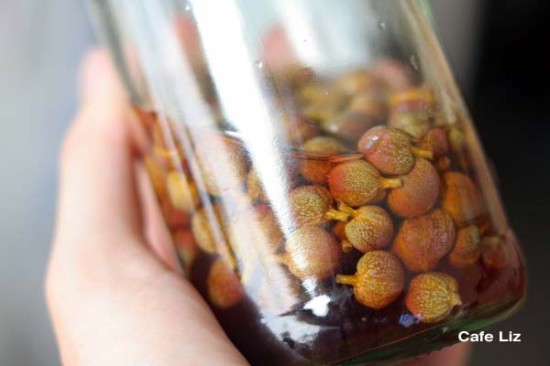
The pickled capers we most commonly eat are flower buds, picked in the morning, before they have time to open. If left to flower, the caper will produce a droplet-shaped berry, which can also be pickled. The berries are served as tapas in bars in southern Spain, alongside beer (they may have other uses, but that's how I've seen them). The Greeks, who utilize their capers better than we do, eat the leaves and branches of the plant too.
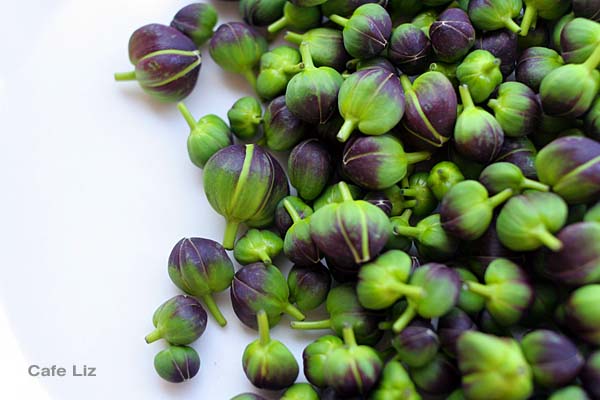
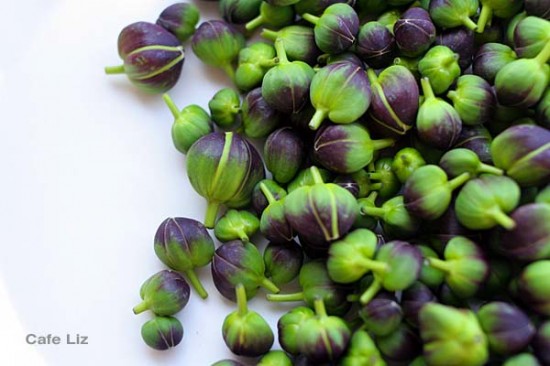
Before being pickled, these buds were a bright green with beautiful royal purple tips. They were also quite astringent. The pickling process mellows them out, and brings out mustard oil and rutin, a compound found in the herb rue, which crystallizes into little green and lavender spots on the pickled bud's olive-green skin.
While there are many different ways of preparing the brine, I chose the simplest method -- vinegar, water and salt. You could also add spices and herbs, like bay leaves and peppercorns, but I wanted the caper's flavor to dominate.
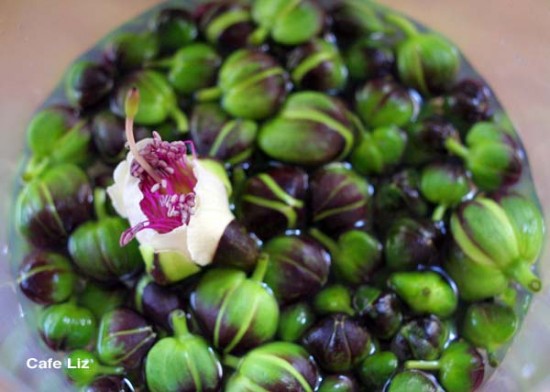
After a quick rinse, I put half my capers straight into the brine. The other half I left in water and rinsed daily for three days (one of the larger caper buds blossomed, water-lily like), before putting them in brine as well. Both batches were ready within six days, although the capers that spent three days in water had a milder, less astringent flavor.
The quantities below yield one small glass jar full of pickled capers. (The jar in the photo is half the batch.)
To prepare 100 grams of pickled caper buds:
1/2 cup wine (or sherry) vinegar
1/2 cup water
1 tablespoon salt
Rinse the capers, and discard any with worm holes. Let the capers soak in water, and rinse and replace the water once a day for three days.
Prepare the brine mixture of vinegar, water and salt in a jar, and add the capers. Let sit for another three days. The capers and will then be ready to eat, but also can be left to sit for a longer period of time.
Once pickled, store the jar of capers and brine in your refrigerator.
More links about pickling capers:
- A Greek Web site that explains how to prepare capers
- Instructions for preparing capers on a Cretian cooking blog
- Capers in several languages and cultures
Botanical information about caper plants in Israel:
- Pictures and history of the common caper in Israel
- Pictures and information about growing season and locations
More of my pickling guides: Do-it-yourself olives #1 (basic pickling technique), and do-it-yourself olives #2 (extensions).