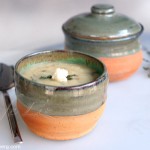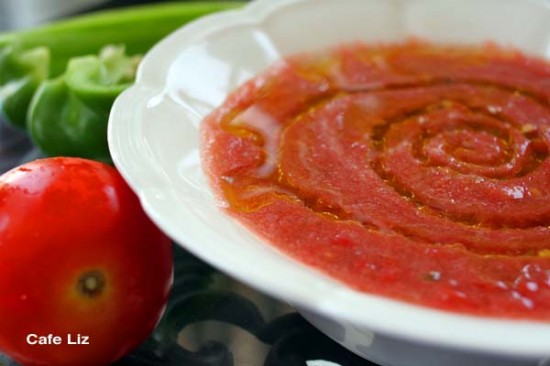
This recipe made half a dozen grown Spanish men swoon. It’s another recipe I learned from my time in Madrid, in Sra. Pilar’s kitchen. Summer was at its peak, the days were regularly 40 degrees Celsius, and she’d keep a big, glass bowl of cool gazpacho in the fridge. We’d put a few ladles in a bowl and eat it on the oilcloth-covered table, with a handful of crunchy mini-breadsticks. Simple food.
The key to good gazpacho is in the tomatoes. They have to be rich, ripe and red; otherwise the soup will have no flavor. That’s another reason that gazpacho suits the summer.
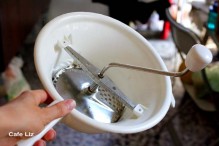 The other key to good gazpacho is that weird device in the photo. It makes the soup smoother after it’s been blended, and takes out bits of peel. (Update: It’s called a food mill, and sometimes a rotary spaetzle maker; my model is similar to this one.) If you don’t have one of these, you’ll have to peel your tomatoes, and you want might to make the whole thing in a food processor, instead of using a hand-held blender.
And what about all the men? I made this for a friend — a Spanish embassy worker in Tel Aviv. He was having a Spain-themed party, so I said I’d bring gazpacho. He told his friends, who apparently derided the thought of a non-Spaniard making gazpacho worth anything — until they tasted it. It was just like their mothers made it, apparently, and I was surrounded by swooning men. If that’s not testimony to this recipe, then I don’t know what is.
Sra. Pilar would make a lot of gazpacho, and I’ve cut her recipe in half — hence all the half-vegetables. She also would add a full cup of olive oil. I think that’s a lot, if not entirely unnecessary. I prefer just drizzling some good olive oil on top.
You can find more of my Spanish recipes here.
For about 4 servings:
1 kilogram red, ripe tomatoes
1/2 a green pepper
1/2 an onion
1 garlic clove
1 teaspoon salt
1/2-3/4 cup water
Optional toppings:
good olive oil for drizzling
mini-toasts, crackers or croutons
If you don’t have a nifty strainer device like the one in the photo, start by peeling the tomatoes: Dunk them in boiling water, remove, and peel off the skins.
Quarter the tomatoes, removing the stem bud, and put them in a glass bowl. Slice the onion, garlic and pepper into large chunks and add. Dump in the salt. Blend with a stick blender (or in a food processor). If you’re using a stick blender, start with the tomatoes, since they’re more liquid and once they begin to blend, it’ll be easier to blend the peppers and onions as well.
 Put the strainer on top of a large glass bowl, and pour the gazpacho into the strainer. Turn the handle to push the soup through the strainer. Once almost everything has gone through, pour the water into the strainer and give it a few more spins, to get out any remaining soup (you should see a thick layer of vegetable peels in the bottom of the strainer — you don’t want these to go through.) Peek underneath the strainer — if it’s mostly pulp stuck there, scrape it off into the soup. If it’s mostly peels, dump it.
Serve in bowls and drizzle with olive oil. It’s good alongside crackers or another dry bread product.
Passover variation: Matzo instead of crackers.