January 11, 2012

What makes a beer Israeli?

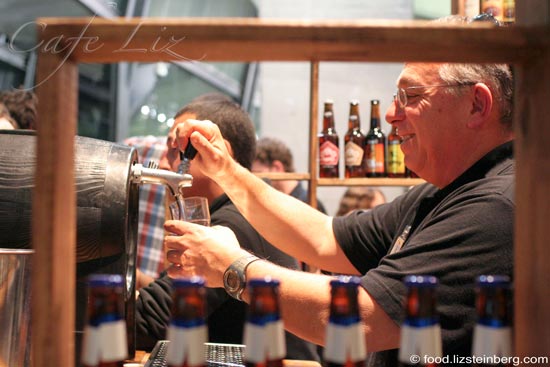
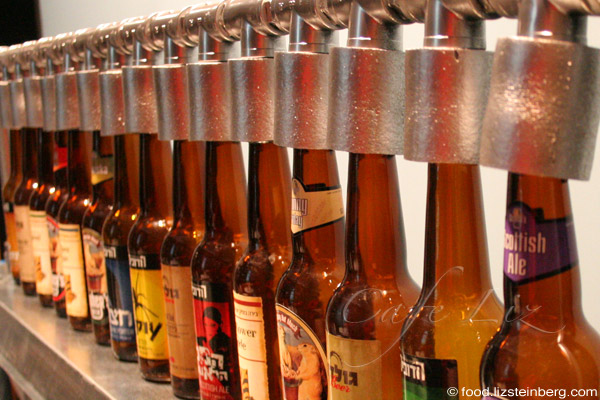
Is there such a thing as Israeli beer, and if so, what makes a beer Israeli? I’m not the first person to ask that question, but it comes up again on the occasion of Israel’s second-ever beer expo, Beers 2012.

The local industry is young but growing, with a profusion of microbreweries and home breweries — enough of them to fill a stadium (Nokia Stadium, to be precise). But while the beers are brewed here — even the mass-market Danish brands Carlsberg and Tuborg — nearly all the raw ingredients are imported. The malt — made abroad in a water-intensive process; hops — grown elsewhere, since the plant likes cold weather. In fact, as a liquor store owner disdainfully pointed out to me last year, even the beer styles are imported — Pilsner, Stout, Lager, Ale, Tripel. (Of course, the same could be said for “local” beers from many countries, but that’s not our focus here.)

Now, unlike that liquor store owner, that doesn’t mean that most of us intend to refrain from drinking locally-produced craft beers because there’s nothing distinctly Israeli about them. What it means is that coming up with a truly local, Israeli product is difficult. Continue reading What makes a beer Israeli? …

More on: , ,
January 13, 2011

Brewing up a beer culture

Does Israel have a beer culture? Well, kind of. A young one. One that’s perhaps largely imported. What it does have now is a beer expo. To be precise, Israel has had one beer expo to date — yesterday was the day for professionals, and today it’s open to the public at large, all those beer drinkers who want to get to know the country’s importers and microbrewers.

Continue reading ...
More on: , ,
April 14, 2010

Brandied loquats

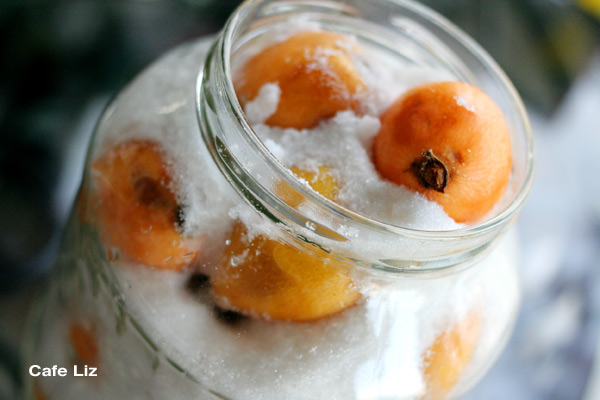
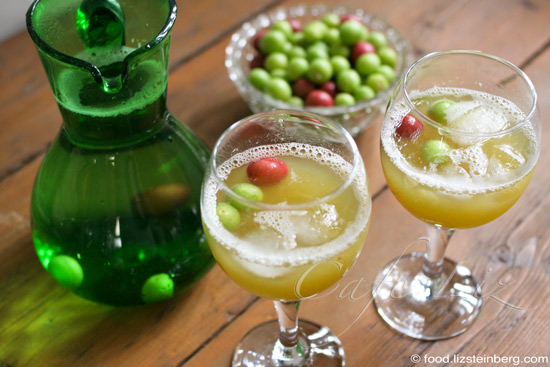
All it takes is one ingredient to turn loquats (or any other stone fruit) into a sweet, alcoholic concoction: sugar. This fabulously simple preparation comes from my sister-in-law Ora, who got the basic concept from the Encyclopedia of Country Living. Ora presented us with little containers of brandied loquats for Purim. We couldn’t stop eating them, and we couldn’t believe they were that easy to make. Now that loquats are finally coming into season, I gave it a try myself. [...]

Continue reading ...
February 7, 2010

Spiced wine with quince and roses

People, believe it or not, I've found a use for kiddush wine. For those who have never had it, it's a traditionally sweet wine to represent the sweetness of blessings, but there's just so much sweetness a person can handle until terms like cloying and sickly come to mind. But add some spices and fruit, and heat it up, and it's actually quite nice. There you have it, mulled wine, no sugar added. Good for the cold weather, too. A [...]

Continue reading ...
July 26, 2009

Dulce de leche liquor

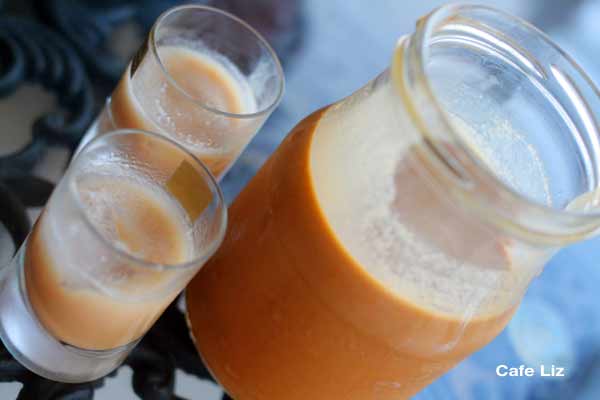
I first encountered dulce de leche liquor when I was around 20, on a trip to Buenos Aires. Always one to travel light, I went with only a small backpack, which made my mother all the more amused when I returned home, having managed to stuff five bottles of wine and two bottles of dulce de leche liquor into that little bag. (Ah, the good old days, when you could still bring liquid onto flights). Shortly after, she “confiscated” one [...]

Continue reading ...

Cafe Liz: Kosher vegetarian recipes, Israeli food culture, a mix of the Mediterranean and the Middle East.

All content and photos copyright 2008-2012, Liz Steinberg. All rights reserved. Please seek permission before republishing.
Powered by WordPress with theme based on Pool design by Borja Fernandez.

All content and photos copyright 2008-2012, Liz Steinberg, at Cafe Liz (food.lizsteinberg.com). All rights reserved. Please seek permission before republishing.